Wednesday, August 14, 2013

AUG 14 - 2 1/2 DAY TOURS = 1 LONG DAY TOUR

Another great day on the island.  We left for the tour at 9 AM, and first drove to a cave that was used by the Rapa Nui people.  They could stay there for shelter, and use the calm entrance as a boat ramp.  There were some cave drawings inside, but weather and my photos really didn't show much.  The "paint" was ground red and black stone mixed with water and fish oil.  They used coral for white.
John told us the local people like to swim in these areas since the tourists like to hang around the white sandy beaches.  This way the locals get some privacy.

During the late 1600's and early 1700's some locals mostly due to starvation fell to cannibalism.  Those that did were sent to this cave.  Not much of a way out of there.
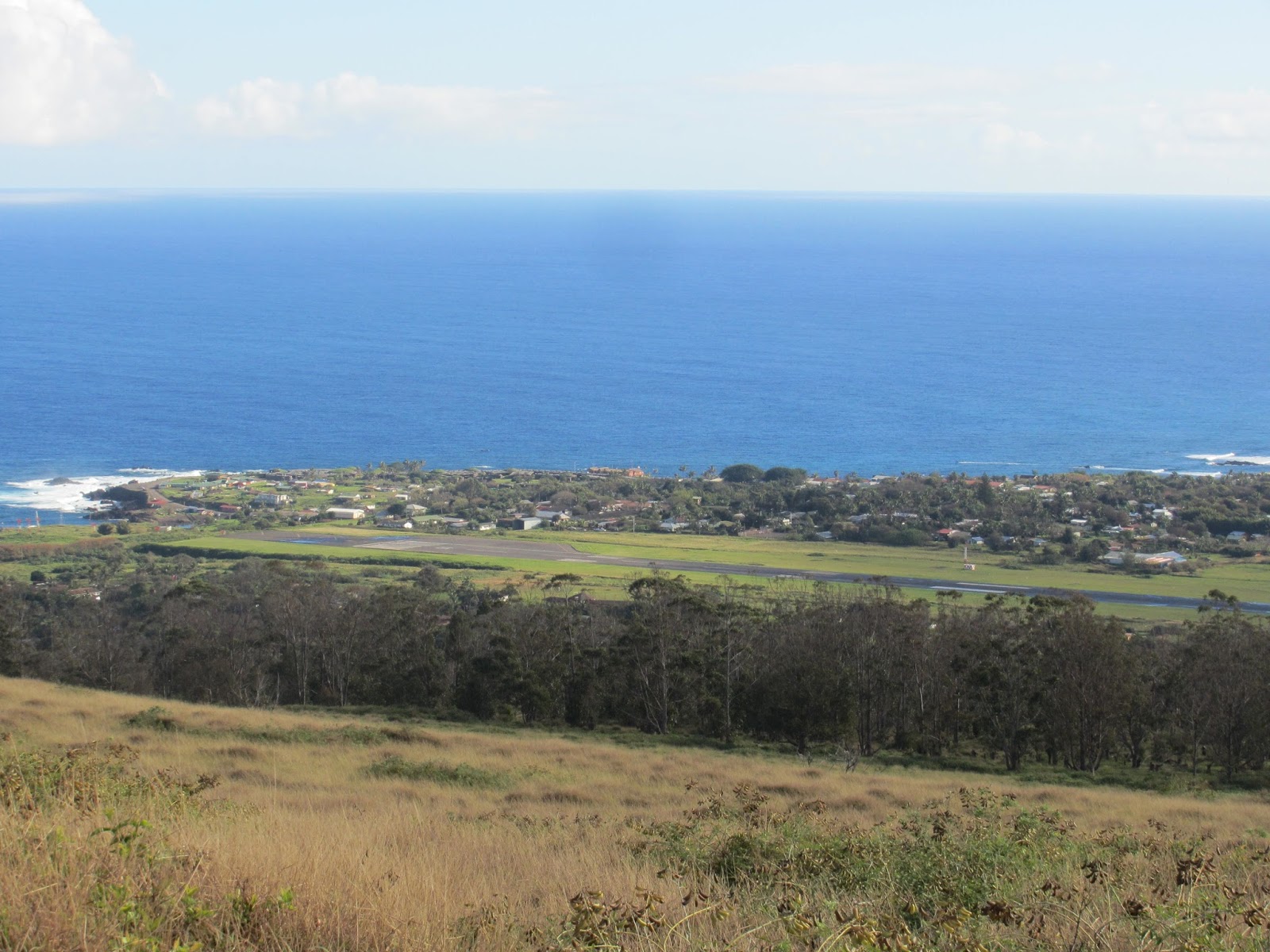
We stopped for a beautiful overlook.  The town of Hanga Roa is in the distance.  In between the trees and the town you can see the air strip that we landed on.  One plane comes in each day.  Monday there are two planes, one of which goes on to Tahiti.  The strip was originally built by NASA as a back up landing strip in the middle of the South Pacific for the shuttle program. 

When the British came to the island they brought sheep, eucalyptus trees, and fenced all the islanders into the Hanga Roa area.  The sheep, British, and the fence are now gone.

 Our next stop was a crater view of Rano Kau.  This one like the other we saw is full of water.  Apparently when the British came around 1850 they brought the natives clothes.  The only place to wash their new clothes was the bottom of this crater.  You could see a little trail leading down the sides of the crater to the water.  The greenery in there is a type of reed.

Us at the crater.

Today's big history lesson was the story of the Birdman Competition.  After years of fighting amongst themselves - Moai tipping, murder, and the like - a king had a brilliant idea.  He decided to eliminate the Moai ancestor worship and to bring in a competition.  The Petrogliff below shows a birdman depiction. Bird's head to the right (beak upwards) man's arms upward and legs to the left.
For centuries in the spring around here (September) Sooty Terns would land on the largest of the little islets in the photo below.  Seven clans would come to Orongo (site of the competition) and wait for a birds to land on the islet.  When the birds would take off for food, the competition was on...


Us at Orongo

Housing for the contestants and their entourage.  A chief, a priest, and two other warriors who came along, just in case.

The contestants and to first climb down the cliff face that was a wall of the volcano.  They then had to swim to the islet, find a tern egg, stick it on a headdress so he could swim back to shore.  The swim is about 1400 m, but they did have reed floaters to help them. The first person to do all of this became leader of all the clans for a year.  The head birdman.

We then went back to the hotel, had a great lunch, then hit the road around 2:30.  Our first stop was Puna Pau.  It is a quarry for the red, volcanic tuff (a welded volcanic ash) that was used for the topknots on the Moai's.  

Above is an abandoned topknot.

The Puno Kau quarry.

Our next stop was Ahu Akivi.  These Moai were different in several ways from the Moai we'd seen at the coasts.  First of all there were seven of them sitting about in the middle of the island. They were roughly the same size, and the platform that they sat on was not filled with bones - it was purely a platform.  On the day of the Fall equinox (March 21st around here) the sun rises above the middle of the seven Moai.


The equinox Moai.
 Our next stop were the Lava Tube caves at Ana Te Pahi.
John next to the sign for the caves.  We had just ridden across what must have been the worst road I've ever been on.  Pools of water, enormous ruts and holes, and stones of all sorts and sizes blocked the road.  Good grief.
Below are a few photos from inside the cave.

We went in and out of one cave, then John asked us if we wanted to have an adventure.  He said he had a flashlight.  We ended up walking about 200 m in the cave - only a flashlight to see where we were going, and scrambling over damp rocks, made it a real adventure.  The only places where we had to crouch was getting out of the cave at the end.  I'm real brave if I can stand up in a cave.

Our last stop was Tahai, the place Charlie and I had walked to our first day out.  The photo below show the Moai and in the distance behind them, is our hotel.


One more touring day - until tomorrow.


Tuesday, August 13, 2013

AUGUST 13 - A FULL TOUR DAY

After breakfast this morning we were picked up at the hotel by John, our guide for the day.  He is 100% Rapa Nui (it means "big island" in the native language).  The population of the island has about 1000 pure islanders, 3000 mixed people, and about 2000 people who rent homes here.  Apparently, you can't buy property on Easter Island.  We asked John if his could understand other Polynesian people.  The easiest for the Rapa Nui folks to understand were the Maori from New Zealand.  Then the Tahitians (they could understand about 50% of what they said.)  The Hawaiians were really difficult to understand (only about 10%) because the Hawaiians introduced the "L" sound which isn't in the other Polynesian dialects.

Our first stop was Rano Raraku.  It was the quarry for the Moai for the island.  They were carved here then dragged (many different theories as to how they managed to do this) to various sites around the island.  The Moai below (behind us) were in the process of being excavated and were never transported for various reasons.
The largest of the Moai are 23 meters.  They have bottoms as well as tops, most of each statue is left underground to help preserve them.

There are two Moai in the photo above - one was in the process of being carved out of the rock when the carvers gave up.

Another view of the fallen and rejected Moai.  

The Easter Islanders, after a very auspicious beginning, broke into 15 clans who then began to fight one against the other.  The ultimate result of the civil war amongst the clans was they toppled over the Moai from each clan.   The ones that are upright today have been re-set up to see what they looked like before the battles.

The Moai above is the only one who's in a kneeling position.  The archeologists who uprighted the Moai decided to leave the bottom parts of them underground to keep them preserved.  The weather, lichens, and all does real damage to them.

We then went up to the crater of the Rano Raraku volcano. There was a lake in it. The reeds around the lake which float on it are the only naturally occurring plant left on the island.

John and Charlie sitting near the lake.  John told us about a native tri-athelon in this crater.  1st a canoe race across the water, 2nd carting 2 twenty kilo stones running around the lake, and 3rd ran up inside the caldera grabbed a paddle board and swam across the lake.

We then went to Ahu Tangariki (Ahu means platform - it's the stone platform that the Moai were meant to sit on)
John is showing Charlie the remains of the Rapa Nui house structures.  Basically the size and shape of the canoes that brought them to the island - the roof looked like overturned canoes covered in grass.  They were only used for sleeping.

The quarry from Ahu Tangariki

Charlie and John near a collapsed Moai - 15 standing Moai in the rear.  The Moais actual direction was always away from the coast facing the people who lived near them - they eyes facing the stars

The 15 Moai behind us represent each of the 15 clans.  An attempt at peace which apparently didn't work.  These Moai were knocked over a 2nd time in a tsunami which occurred after the 1960 Chilean earthquake.  


Next on our tour Aka Hanga.  This was a site of a platform that was in the "original" condition after the warring clans got done knocking over each others Moai. In the platforms under each of the Moai are the bones of the person for whom the Moai was constructed.  Apparently  the bones have been taken from the platforms that have been reconstructed.  The one below still has the bones remaining in it. 

The site for the platforms had to have several basics:  1.) an inlet so they could get out and fish  2.) a raised hillside 3.) water and 4.) a cave - like the lava cave below - which was used for (among other things) a birthing chamber.


The inlet (and view) from Aka Hanga

 In the afternoon we went to Te Pito Kura.  It was the site of another platform and collapsed Moai.  In the distance you can see the edge of the oldest volcano on the island.  There are three main volcanos that make up Easter Island.  The other thing that was here was a round stone which had more iron than the average stones and was magnetic.  Apparently, it was a very popular and mystic thing to sit and feel the magnetic vibes.  Good grief.


Our last stop was Anakena.  One of the two sandy beaches on Easter Island.  The sand was amazing white, ground-up coral.
Souvenir stands and snack shops near the parking lot.

These Moai in the foreground were very well preserved.  The thinking goes that they had been buried in the lovely sand and that kept them in great shape.  The Moai in the background was uprighted by Thor Hyerdahl.

Charlie on the beach.  We both went into the water.  As John said, "It's fresh" AKA brrrrrrr.


Monday, August 12, 2013

AUG 12 - OUR FIRST NIGHT ON EASTER ISLAND

Right before we left Iguazu, the skies cleared and I got a great shot of the Devil's Throat from our room porch.
We took our two flights right after the picture was taken and spent last night in Santiago.

Our trip has been delightfully smooth.  Our one and only glitch turned out not to be so bad after all.  When we got to the airport last night we decided to check to see if we could get boarding passes early for our flight this morning.  Good thing we did.  With a bit of messing around we managed to get on-line and get two of the last four available seats on the flight.  Unlike Aerolineas Argentina which is a last minute grab-your-seat, LAN airways (the Chilean airline) has the old 24 hour before flight time check in like the US airlines do.  The key difference is that unlike US airlines that assign a seat when you buy your ticket, LAN gets you the seat when you check in.  Not only that but the flight at 8:15 this morning is the one and only flight out of Santiago for the day.  The flight was chock-a-block full.  Fortunately, I asked the woman sitting next to me if she mined moving so Charlie could sit next to me.  She actually was planning to re-arrange HER seat so that she could sit next to HER husband.  I think there's something awry with LAN's seating.

The LAN flight was great and we landed here at 11:30 am.  We got to our hotel (Hanga Roa Eco Lodge and Spa).  Easter Island is very rural - chickens, horses, farms, and a tiny little town (Hanga Roa), and the heads, of course.  We had a great lunch.  We also had breakfast at the hotel early this morning, and another breakfast on the plane.  We're beginning to sound like Hobbits with a first and second breakfast.  After all this eating we decided to hike out to 1) see our first set of heads and 2) walk into town for some souvenir shopping.

The photo below is from our room.  Hanga Roa is in the distance.

A closer look at Hanga Roa.

Our self-guided "head" tour (Moai) was very successful.  These weird things don't seem so big until you see someone standing near them.  They kind of fit into the scenery.  I love the hat? topknot? on the guy I'm standing near.  We get a formal tour tomorrow so I can tell about the Moai in more detail.


The town of Hanga Roa is very small with only about 3000 or so residents.  Most of the people here are tourists from one place or another.  More tomorrow - good internet access in the room!  Hurray!

Sunday, August 11, 2013

A NIGHT AT THE AIRPORT HOTEL IN SANTIAGO, CHILE

We are at the Holiday Inn in Santiago, Chile.  The hotel is literally right across a street from the terminal.  We flew from Iguazu Falls, Argentina to Buenos Aires.  Then another flight from Buenos Aires to Santiago.  Not much else to describe today.  It really is amazing how tiring doing very little can be.  Checking into and out of planes and airports.

A note about eating in Argentina.  EVERYTHING has ham on it.  I got a hamburger - it had ham.  Almost all sandwiches were ham and .....  fill in the blank.  Jamon cocido (what we think of as ham in the US) and Jamon crudo - Prociutto Ham.  There's also a big emphasis on potatoes.  I don't remember so much ham the last time we were here.  Kind of Monty Pythonesque Ham Ham Ham and Ham.

Until tomorrow in Easter Island - with photos.

Saturday, August 10, 2013

FULL DAY IN IGUAZU FALLS - SATURDAY

We met Hector, our guide, at 9 this morning.  Unfortunately, the rain still hadn't stopped, but it was a lot less than last night.  We started our first hike on the upper trail.  On this trail you can get good side views of the falls and very eerie edge-over views.  The rain and temperature of the water created these very Japanese/Chinese-like misty photos.  Here's one of my favorites below:


Our hats and coats were necessary, it was raining and about 55° F.  Welcome to the sub-tropics.  It was 80° last week - we missed that one.

I saw this fellow flying along - fortunately he stopped for a photo.

Another misty-moody falls shot.  The number of waterfalls here is unbelievable.  

The upper trail is moderately short. 

We took a little train that takes you to a pathway that goes across the sections of different rivers that end in falls that create Iguazu.  Seemingly quiet, there are lots of little islets and rocks.  Not far away are the amazing drop offs.

I spotted this little bird and couldn't resist.  He was all by himself just sitting in the middle of a huge section of river about to barrel over the falls.

The highlight of this walkway is that it ends at Devil's Throat - the largest of the falls.  Charlie and I are close to Devil's Falls, but not quite there yet.

This chain of waterfalls is on the way to Devil's Throat.
Me at Devil's Throat.

Us at Devil's Throat

Charlie at Devil's Throat.  
The problem with fuller Devil's Throat photos is that 1.) it was filled with so much mist you couldn't see much and 2.) it was filled with tourists knocking each other over for better photos so the few below are the ones we like the best - full of us of course.


 We then began the lower trail after another train ride.
The nifty bird above is called a Plush Crested Jay.  They are quite common here - and I think I'm in love

Coaties are easy to see around eating places.  We didn't stop to eat, but the Coaties were out in force.
A local woodpecker.

The reason I've posted this picture is the photo of the boat.  More about that to come.


A photo of a bank of falls from the lower trail.

And we thought we were getting wet - 

We really didn't know how wet we could get

Double sets of double falls.

At the end of the lower trail we got into a boat with a lot of others.  We needed 1.) a life jacket 2.) rubber bags to hold our gear 3.) "rain proof jackets" - we failed at that one 4.) at the advice of Hector - another rubber bags to hold our shoes and socks.  Very smart move.  We got into the boat with us and a load of young adults (they thought this was great fun) - I can hardly stand the pool before the end of the summer.  They screamed, they cheered - we all got drenched as the boat ran into and out of the falls.  At one point a wave swooped over  us - I was beyond drenched.  See photo below.  


Racing back up 170 steps and about a 500 meter trail in sopping wet clothes, I did stop of a photo of a Southern Lapwing below. I missed the aguti though, sigh.

We got back to the hotel, had a bite to eat.  After drying our clothes - a la hair dryer - we went back out in the late afternoon for a stroll.  We took the upper trail again.  Everything closes by 6 - so here we are ending our evening in the hotel bar writing this to you with free wifi.


Late afternoon sun on Brazil

South American Guinea Pigs - they're all over the place.  Charlie suggested this fellow should be happy he wasn't born a few countries to the north where he'd be dinner.

Sun on the evening mist!