Thursday, July 12, 2012

A DAY IN KUALA LUMPUR - BATA CAVE

We had breakfast at Shook, a cafe on the ground level of the hotel.  There were lots of people this morning and we had to wait more than 10 minutes to sit down.  Charlie said to the floor manager that it would be difficult if people had to wait that long and then had to go out on tours.  The manager came over and apologized to us.  We later received some candy.  Good grief.  We really weren't complaining that loudly.

Chris came again to take us to the Bata cave.  It is a Hindu temple with 271 steps into the cave, and a few more inside for good measure.  See the photo below.


Every 17 steps there was a landing to rest on.  I wasn't winded (neither was Charlie) but my knees felt like they were seizing up.  A quick rest and off we went.  Below are some views from several levels up.


Above, from inside the cave.

Inside the cave, as I mentioned, were a few more steps to another small shrine.  We went to the top.
The shop above was one of many for worshipers to buy things to leave at the shrines.  Souvenirs, too, were sold, of course.

Long-tailed macaques were running all over the place in the caves.  One woman almost lost her purse in an attempted robbery - a la macaque.  Another woman lost a bottle of soda.  The macaques are cheeky, but nervous, so when someone began to chase the soda stealer, he dropped the soda.

Stalactites with a little help from Charlie.  Chris is off to the side. 
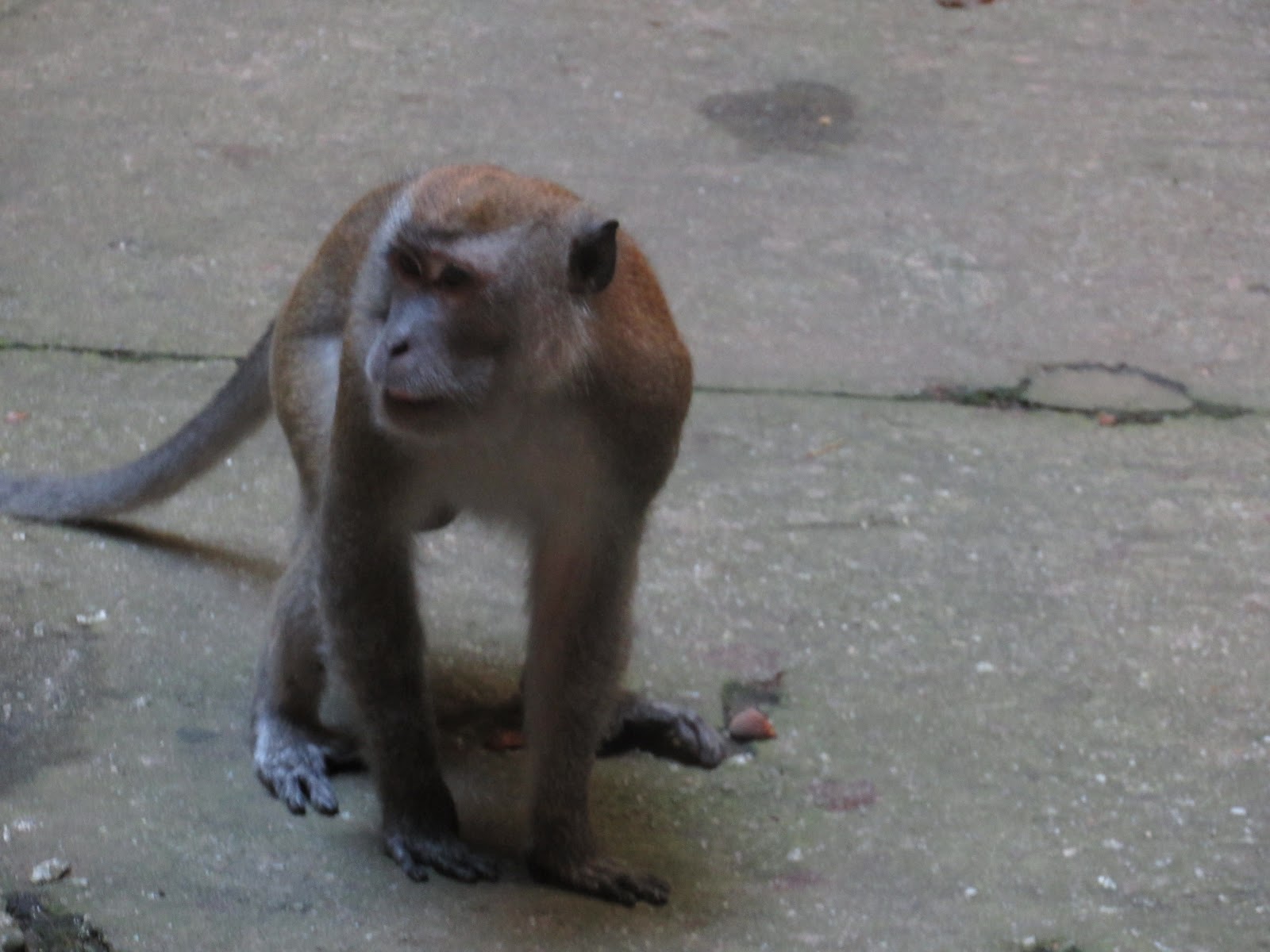
Another macaque.

After our cave adventure, we were brought to the Selangor Pewter factory.  Charlie and I are standing in front of the Guiness world record stein made out of pewter below.  There had been tin mining in the Kuala Lumpur area, but a Chinese man learned how to smelt pewter.  His factory was going along OK, until the British came along and fell in love with pewter for beer mugs.  The Chinese factory owner became fabulously wealthy.  They did have lovely pewter things.   We ended up buying a tea container with a Chinese dragon on it.  Supposedly it will keep tea for up to a year.  It's pretty even if it doesn't.
Coming into town, Chris found a spot to show us the Kuala Lumpur twin towers.  Our hotel, apparently, should have had a view of them.  Yesterday, Charlie and I were looking out a window trying to spot them.  A bellboy told us he'd give us a quick view.  We went into the executive club in the hotel, but, no, you still couldn't see them.  Somebody had built a huge skyscraper blocking the view of the towers from the hotel - even for the execs.  The towers were built by an oil company.  The tower to the left is for oil company offices, the one to the right has offices that are rented to various companies.


When we got back to the hotel, we decided to explore the neighborhood some more.  The photo below is from the inside of ONE of probably 20 huge malls that are within easy walking distance of our hotel.

We then decided to walk to the twin towers.  Our stroll was a little like a hamster habit trail.  The photos below are of an above-the-ground walk way that led 1.) to the convention center and 2.) to the base of the towers.  We really didn't get a great tower view, but the walk was really fun.

There's a lovely park at behind the towers near the convention center.  Charlie is standing near it.  


Tomorrow we fly off to Pangkor.  It's official name is Pulau Pangkor which translates to beautiful island.  I hope so, we are there for two days.  It's another resort, but here's hoping for the best.......

KUALA LUMPUR - MALACCA

We arrived at the hotel (a Marriot) in downtown Kuala Lumpur at about 1:15 in the morning.  Since we had been up at 5 am, we were really pooped. A great night's sleep made all the difference.  At 9 am, after breakfast, our tour guide (Chris) drove us to Malacca.  It was the first settlement on the Malaysian peninsula.  It was first settled by a prince from Sumatra who immediately called himself Raja (king).  Malacca is a city state on a river leading into the ocean.  A great place for trading with other places, which he then did.  He converted to Islam to better improve his trading prospects with his neighbors.  

About 10 years or so after he got started, the area was conquered by the Portuguese, who set up Catholic churches all about, and continued the trading.  About 100 years later, the Dutch conquered the Portuguese, and changed all the Catholic churches to Protestant churches.  Eventually the Dutch made a treaty with the English, so the English took over Malacca, and changed all the Dutch protestant churches to Church of England.  During World War II, the British took off, and the area reverted to about 60% Muslim.  About 10% of the Malaysian population is Indian - mostly from southern India, and there are several other groups as well, including, of course, the indigenous people.

We went into a museum to get an overview of the history, and a few artifacts left over from the various occupations.  Below is a clock tower built by the British.

Below is the main square.  The red color was for convenience.


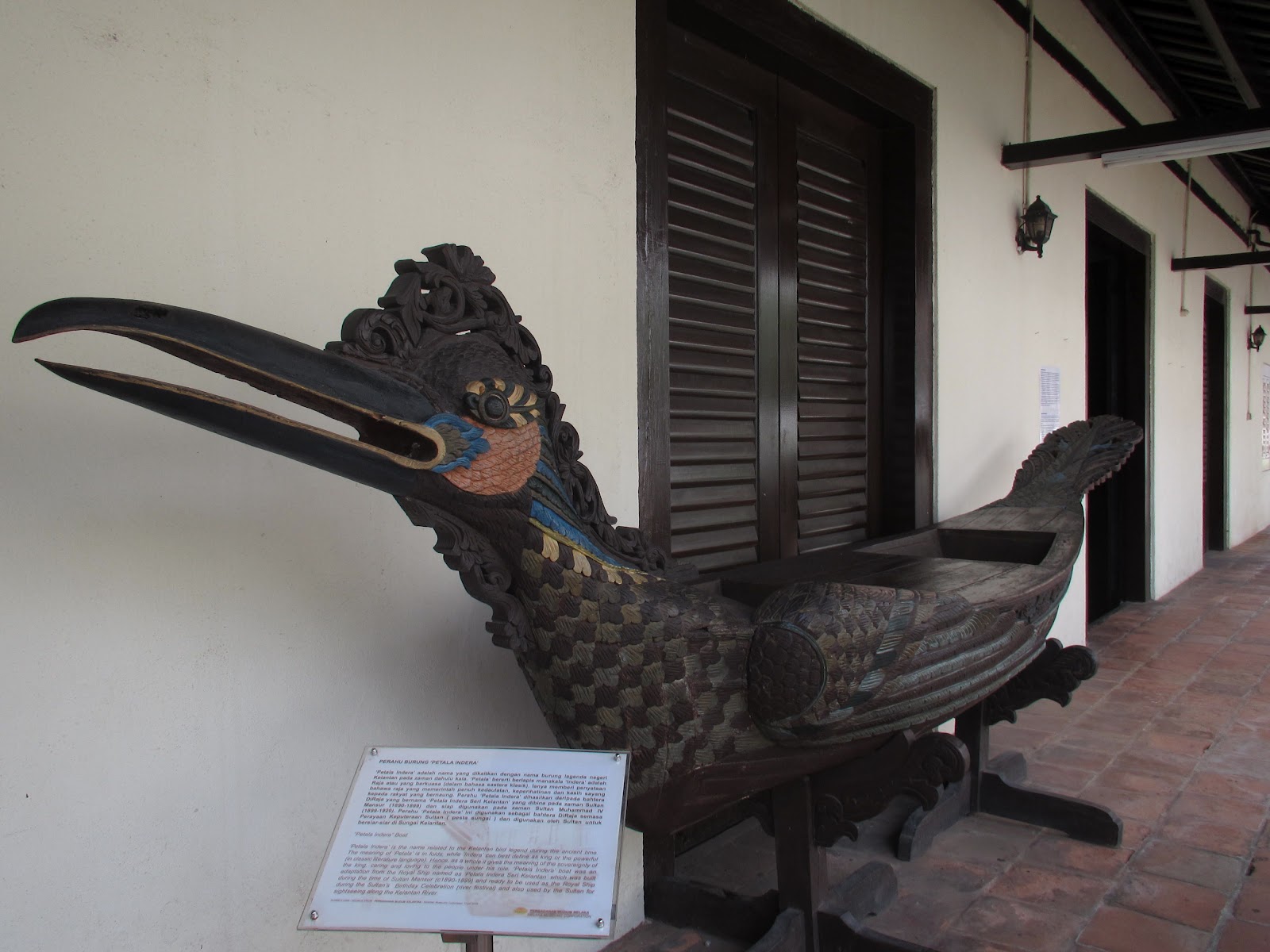
A nifty bird boat we saw at the museum

The church above began as a Catholic church.  The man in front was a kind Jesuit priest - now sainted. The odd tower in front was created by an Englishman (Farquar) who turned the bell tower of the church into a lighthouse.

The British colonial house above

The walls of the Church were three feet thick.  Charlie is standing in a hallway above.

The building above was all that was left of the original walls that surrounded Malacca.  Farquar - the same British guy who built the lighthouse, was commanded to knock all the walls down.  By a fluke - his bombs stopped before they all got knocked down.
A copy of the original Sumatran Raja's royal residence.  It is built in Sumatran style.

We wandered around the square a bit

Notice the Dutch shaped roof of the church behind us.  It is now a Church of England church, but the roof line remains.


We went into the China town portion of Malacca for lunch.  The gate had a great dragon.

A Chinese Buddhist temple above.
A man making coconut sugar.

The fruit above is called dorian.  It reeks, but is supposed to be delicious.  No one had dared try to give us any as of yet.

Angry birds are everywhere


A typical street in the old part of Malacca.

When we got back from our excursion, we wandered a bit around the hotel.  The area is called the "golden triangle".  There are enormous malls up and down the streets here with almost every name brand you can come up with.  We went into the ground floor of one, and found a food court.  We had a great Malaysian chicken rice dish.  Back to the hotel.

Wednesday, July 11, 2012

SANDAKAN - SIPILOK - ORANGUTANS

We got up ridiculously early (5 am) to catch a plane from Kuta Kinabalu to Sandakan.  Sandakan is on the eastern most tip of Borneo.  It's a small town with a famous orangutang reserve and a depressing past.   Flying out we were told to sit on the left side of the plane in order to get a good view of Mt. Kinabalu - because it was a bit dreary below, I was surprised at the fabulous view we got flying out.

We landed in Sandakan a mere 45 minutes after takeoff.  It's a very small town, comparatively.  Another couple were on the tour bus with us.  Like many other tourists here, they were Australians.  Sipilok begins the ecotour by showing us a short video about what they do there.  The main object is to rehabilitate orangutangs so that they can return to the wild.  They are very endangered with very few of them left.  A female orangutang only gives birth to a new baby once every eight years, so they only have 3 infants in a lifetime.  They are huge, the males can reach 100 kg (220 lbs).  We were then told 1.) to avoid touching them, 2.) not to look directly in their eyes and 3.) not to take flash photos, and 4.) to try to avoid the long and short tailed macaques that were all over the place.  Then they sent us out on a walk on a wooden platform in the jungle.  The baby orangutangs were off limits to see, but the youngsters about 6 years old are sent a small distance from Sipilok and given feedings twice a day.  Gradually, they are given feedings further and further away with the hope that they'll return to the wild.  Our walk ended at the first of the platforms for the youngsters that had just been sent out on their own.  The first creatures we met were the macaques.  Very persistent.  Finally, (the feeding began at 10 am) around 10:10 a couple of orangutangs appeared for some eats.  There were ropes hanging all about and I expected them to come swinging in - a la tarzan.  Instead they slowly climbed a ladder to the platform.  The macaques were obviously anxious to grab the fruit and they seemed to put the orangutangs off a bit.  A lot of the hanging photos below were the off-put orangutangs.

A macaque waiting for the fruit

A macaque on the platform with the feeder fellow

The stars of the show appear from the forest floor


A macaque mother and child - fruit thieves


The orangutang above was on his way back into the forest.
After the reserve, we drove back to Sandakan.  We had lunch at the Agnes Keith house (The English Tea Garden)  Sandakan (as well as Kuta Kinabalu) were bombed flat by the Japanese in World War 2. That explains part of the problem with Kuta Kinabalu.  Any buildings that we saw were all reconstructed after World War II, and the place has a sprawl look to it as a result.  Sandakan not only was bombed badly, but it was the beginning of death marches through the Borneo jungle.  The Japanese were trying to get an airstrip built, but the Australian and British troops kept sabotaging the operation.  Eventually they were forced to march miles to the jungle to get them away from the coast. The soldiers, mostly Australian,  almost all perished (only 6 survived).  They also sent a number of women and children on death marches.  Agnes Keith (an American woman married to an English man who was head of forestry in Borneo) was sent out on a march with her young son.  Both survived.  She wrote several books about the experience.  Her husband was killed.

Here are a few photos from lunch.
Sandakan behind me, down the hill.

A little Borneo bird on the wire 

Sandakan from the hill.

We were then taken to the Memorial garden commemorating all the soldiers who died at the hands of the Japanese during the war on Borneo.  The Japanese, when they were leaving tried to eliminate any proof they were there, but the items were dug up and on display at the memorial.
A boiler left over from the Japanese occupation.

We then had several hours to kill in Sandakan.  We were left at the Marriot hotel where we found a great little cafe with seating by the water.  After we walked all over town (about 30 minutes worth of walking), we walked over to the local market.  It reminded me most of a Malaysian version of Granville Market in Vancouver.  Here are some photos.
View of Sandakan waterfront from our cafe seats.


At 7, we were picked up and driven to the airport.  We took the 9 pm flight from Sandakan to Kuala Lumpur.  The operator of the flight was Asian Airways whose motto is "Anyone can fly".  That's because they make any other airline I've ever been on seem like ridiculous spenders.  I asked for water, and was told that it would cost be 3 RM (3 ringhets  or about a $1 US).  Really?   Once we were underway, we were told that people who had ordered meals/snacks online could be served first.  The stewardesses proceeded to run randomly about the cabin giving people packages - with no particular order.  The good thing - we are now in Kuala Lumpur.